 Ultralight~$319
Durston
Durston X-Mid
No citable rating — see why we hide some.
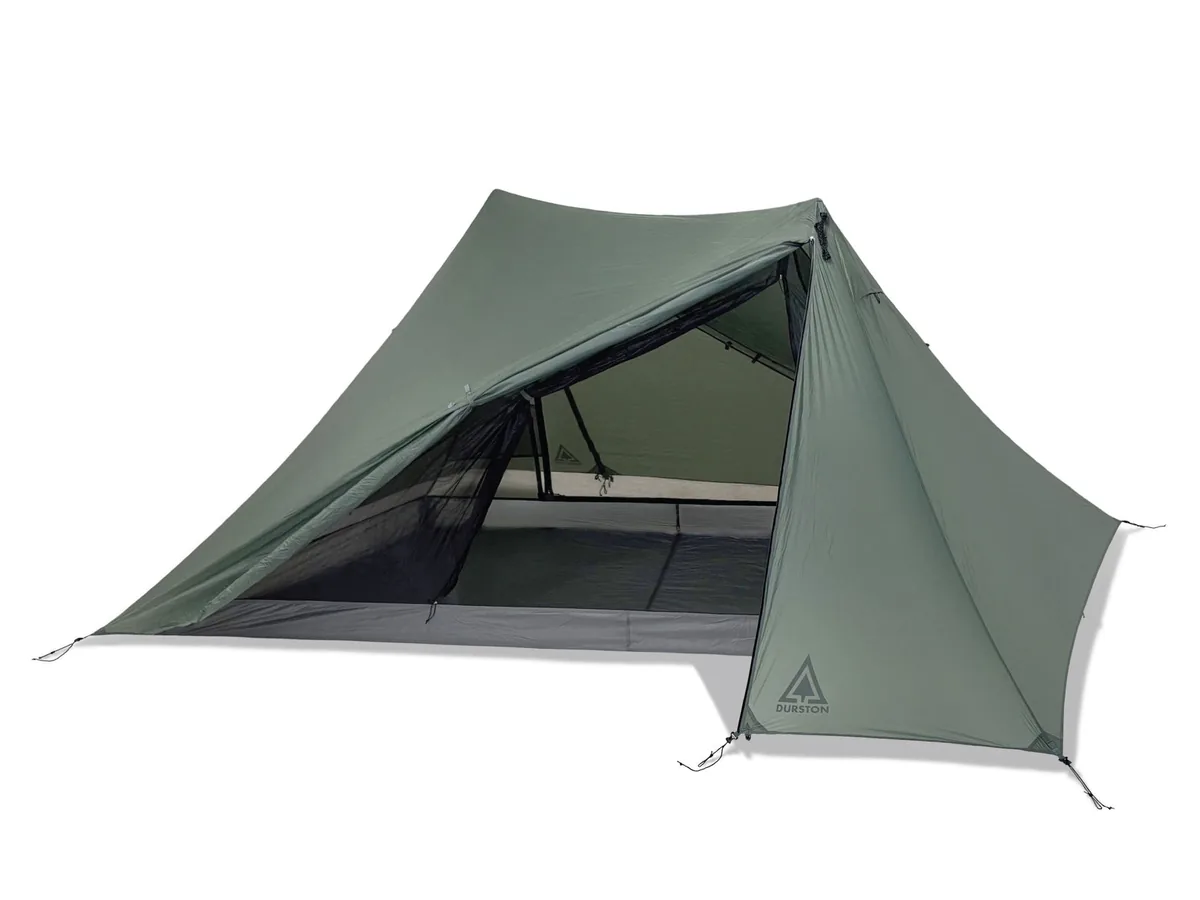
The X-Mid 2 is the most floor-per-ounce tent in this catalog: 33.2 square feet — more than an MSR Hubba Hubba LT 2 — for 31.3 ounces, and $319. The geometry is a rectangle pitched off two offset trekking poles, which puts the poles at the corners of the doorways instead of in the middle of them, and pitches with four stakes. It is double-walled, which almost no trekking-pole shelter this light is, and the 3500 mm silpoly fly does not sag when it gets wet. The catch is the obvious one: no trekking poles, no tent, and the footprint is 65 by 100 inches, which needs a bigger flat patch than a dome does.
Floor area per person
16.6 sq ft
Standard — 14 to 17 sq ft each — the normal two-pads-and-no-spare-room fit
Weight per person
15.7 oz
from the trail weight of 31.3 oz
Peak height
48 in
Approx. price
~$319
Pads: 26.0 in of floor width each — 2 × 25 in pads fit.
Length: a 92 in floor leaves room for a sleeper up to about 7ft 2in once you allow six inches for a foot box and a pillow.
Best for
Anyone who already carries trekking poles and wants the most usable floor per ounce that money can buy.
The size run
One design, 2 capacities. The numbers at the top of this page describe the X-Mid 2; every size has its own figures below.
| Size | Sleeps | Floor area | Sq ft each | Vestibule | Trail weight | Packed weight | Floor L × W | Approx. price |
|---|---|---|---|---|---|---|---|---|
| X-Mid 1 | 1 | 21.3 sq ft | 21.3 | 20.4 sq ft | 26.2 oz | 29.4 oz | 93 × 33 in | ~$269 |
| X-Mid 2 | 2 | 33.2 sq ft | 16.6 | 23 sq ft | 31.3 oz | 34.3 oz | 92 × 52 in | ~$319 |
Specifications
- Type
- Ultralight
- Rated capacity
- 2-person
- Floor area per person(estimated)
- 16.6 sq ft (standard)
- Floor area
- 33.2 sq ft
- Vestibule area
- 23 sq ft
- Peak height
- 48 in
- Minimum trail weight
- 31.3 oz
- Packed weight
- 34.3 oz
- Weight per person(estimated)
- 15.7 oz (trail weight)
- Packed size
- 12 x 6 in
- Interior floor width
- 52 in
- Pad fit(estimated)
- 2 × 25 in pads fit
- Fits sleepers up to(estimated)
- 7ft 2in tall
- Doors
- 2
- Vestibules
- 2
- Freestanding
- non-freestanding
- Poles
- trekking poles
- Wall type
- double wall
- Season rating
- 3-season
- Fly fabric
- 15D silicone/polyester, 3500 mm
- Floor fabric
- 15D silicone/nylon, 3500 mm
- Floor denier
- 15D
- Floor hydrostatic head
- 3,500 mm
- Approx. price
- ~$319
Features
- Offset twin-pole geometry — doorways are not blocked by poles
- Double wall at 31.3 oz, which almost nothing else in this weight class offers
- 3500 mm silpoly fly that barely stretches when wet
- Four-stake pitch, fly first
- Fly and inner separate, so the inner can stay home for a tarp setup
- Sold in 1 and 2 person, with mesh or solid inners
- YKK #5 AquaGuard zippers on the fly, #3 on the inner
In its favour
- 16.6 sq ft per person is roomier than most freestanding tents twice the weight
- Double-walled, so condensation lands on the fly rather than on your bag
- 3500 mm silpoly fly holds tension overnight instead of sagging
- Doorways are clear of the poles, which is the usual annoyance with mids
- $319 makes it the cheapest serious ultralight two-person tent here
- The X-Mid 1 at 26.2 oz has more vestibule area than floor area
Against it
- Requires two trekking poles — there is no pole set in the box
- The 65 x 100 in fly footprint needs a bigger flat pitch than a dome
- Non-freestanding, so wooden platforms and rock slabs need creativity
- 15D fabric wants a groundsheet on anything abrasive
Written from the published specification sheet, not from owner reports.
What owners report
Drawn from archived owner discussions, not from a test of our own.
What owners like
- It is the most-discussed shelter in this catalog by a wide margin, and the overwhelming tone of owner reports is positive
- Zippers glide in a way owners specifically contrast against the big brands they came from
- Fly-first pitching keeps the inner dry, and owners describe being bone dry in an X-Mid where their previous tent would have soaked them
- The designer answers technical questions in public in detail, including about past failures, which owners cite as a reason to trust the brand
- Owners who moved to it from a decade-old mainstream tent describe the upgrade as the best thing they learned from other hikers
- It handles improvised pitches — owners describe anchoring with rocks in deep sand and still getting it taut
Common complaints
- The fly's large panels flap noisily in wind, and owners describe nights where the noise made sleep difficult
- The footprint is large, and several owners say the tent is simply too big for tight pitches — some regret buying it for that reason
- Two people head-to-head is described as unusable by at least one owner, despite the floor area
- Guylines hang loose when not needed and owners fit their own clips to tidy them
- Pitching it in sand or on a wooden platform needs planning — screw eyes or heavy rocks, carried in advance
The X-Mid is the tent this corner of the internet talks about, and the reasons are consistent: it is the cheapest serious ultralight two-person shelter, it has more usable floor than tents twice its weight, it is genuinely double-walled, and it pitches fly-first so the inside stays dry. Owners who moved to it from a decade-old mainstream tent are among the most enthusiastic, and the comparison they draw is about staying dry rather than about ounces.
Both of the real criticisms are about the fly. Its large flat panels catch and flap in wind loudly enough that owners report not sleeping, and its footprint is big — several owners say they cannot find a pitch for it in tight forest sites, and a few regret the purchase on that basis alone. Those are design consequences rather than defects: the same geometry that gives the space gives the footprint.
One unusual point in its favour is transparency. The designer engages publicly with technical failures, including an early-generation issue where certain trekking-pole tips pressed through the grommet and damaged the fly, explaining the cause and the fix. Owners cite that behaviour as a reason to trust the brand, which is rare.
Questions people ask about it
Is the X-Mid 2 too big for tight campsites?
For some people, yes, and it is the most common regret. The fly footprint is about 65 by 100 inches and needs a flat rectangle. Owners who camp in dense forest or on small alpine platforms report struggling; owners in open country never mention it.
How loud is it in wind?
Loud. The fly's large panels catch and flap, and owners describe nights where the noise kept them awake and the tent felt stressed. Extra guylines help; the shape is the shape. A hexagonal-footprint shelter is quieter for the same weight.
Can I pitch it on a wooden platform?
Not without preparation. It is non-freestanding and depends entirely on stakes. Owners who camp on platforms carry a few screw eyes for exactly this, which weighs almost nothing and solves it completely.
Does it need trekking poles?
Yes, two of them, and there is no pole set in the box. Durston sells substitute poles, and some owners have modified theirs to hang from a ridgeline instead — but out of the bag it depends on poles you are already carrying.
Is it really big enough for two?
Thirty-three square feet is 16.6 each, which is roomier than most freestanding two-person tents. At least one owner reports that two people sleeping head-to-head does not work for them, so the arrangement matters as much as the area.