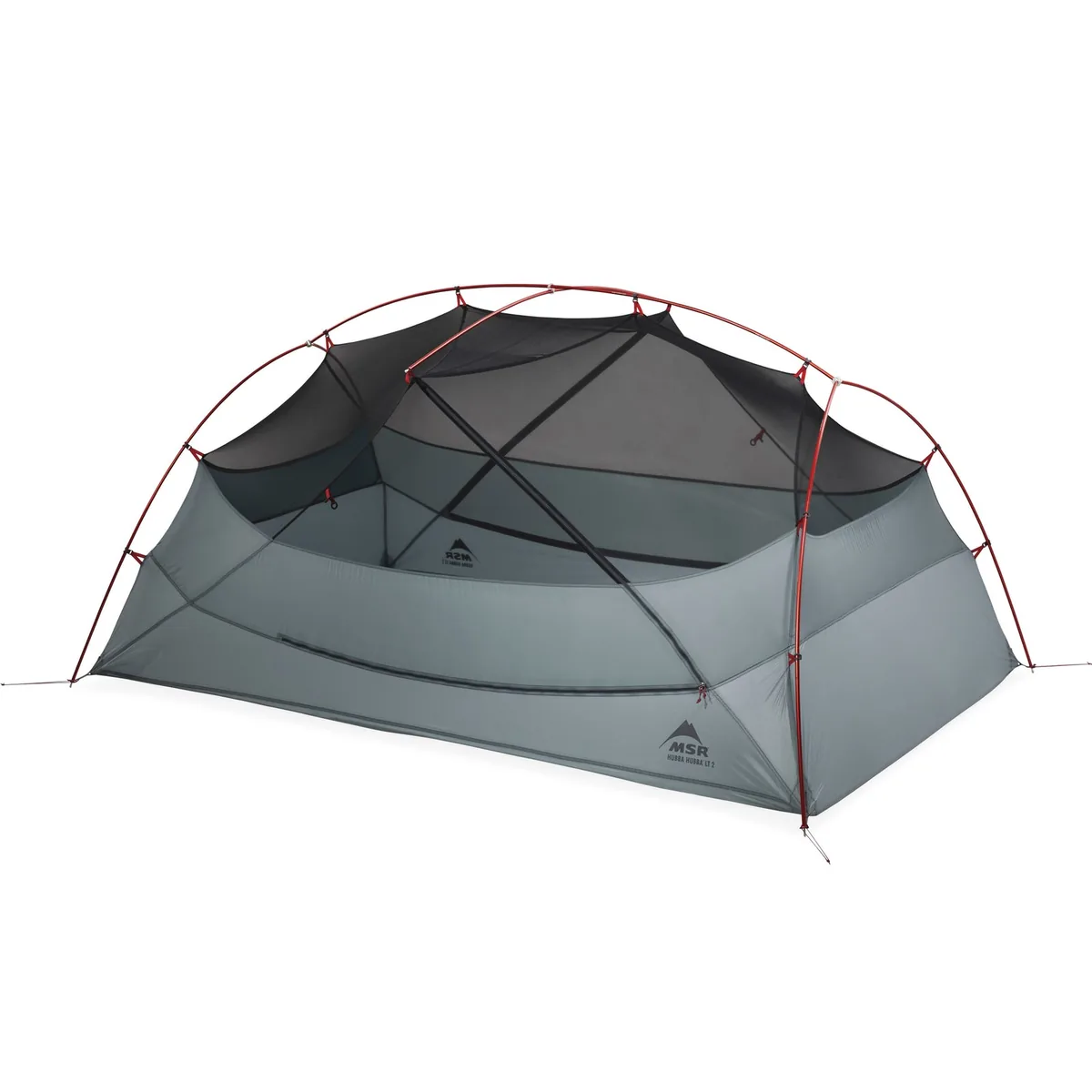
 Backpacking~$550
MSR
MSR Hubba Hubba LT
No citable rating — see why we hide some.
Thirty-two square feet is the most floor of any three-pound freestanding two-person tent here, and the Hubba Hubba LT gets it with a single hubbed DAC pole and a symmetrical shape that holds its width rather than tapering to a point. Sixteen square feet of vestibule, two doors, 40 inches of head height, and a 1800 mm floor that is meaningfully tougher than the 1200 mm tents at the same weight. MSR does not publish interior floor dimensions for this model, which is the one number missing from an otherwise complete spec sheet — and the one that would answer the pad question.
Floor area per person
16.0 sq ft
Standard — 14 to 17 sq ft each — the normal two-pads-and-no-spare-room fit
Weight per person
24 oz
from the trail weight of 3 lb
Peak height
40 in
Approx. price
~$550
Best for
Two backpackers who want maximum floor per ounce in a freestanding tent and do not need a published pad-fit number.
The size run
One design, 3 capacities. The numbers at the top of this page describe the 2; every size has its own figures below.
| Size | Sleeps | Floor area | Sq ft each | Vestibule | Trail weight | Packed weight | Floor L × W | Approx. price |
|---|---|---|---|---|---|---|---|---|
| 1 | 1 | 20 sq ft | 20.0 | 8 sq ft | 38 oz | 43 oz | — | ~$470 |
| 2 | 2 | 32 sq ft | 16.0 | 16 sq ft | 3 lb | 3 lb 6 oz | — | ~$550 |
| 3 | 3 | 47 sq ft | 15.7 | 16 sq ft | 4 lb 6 oz | 4 lb 13 oz | — | ~$650 |
Specifications
- Type
- Backpacking
- Rated capacity
- 2-person
- Floor area per person(estimated)
- 16.0 sq ft (standard)
- Floor area
- 32 sq ft
- Vestibule area
- 16 sq ft
- Peak height
- 40 in
- Packed weight
- 3 lb 6 oz
- Weight per person(estimated)
- 24 oz (trail weight)
- Packed size
- 20 x 5.5 in
- Doors
- 2
- Vestibules
- 2
- Freestanding
- freestanding
- Poles
- DAC aluminum
- Wall type
- double wall
- Season rating
- 3-season
- Fly fabric
- Solution-dyed 20D ripstop nylon, 1200 mm polyether urethane and PFAS-free silicone
- Floor fabric
- Solution-dyed 20D ripstop nylon, 1800 mm polyether urethane and PFAS-free DWR
- Floor denier
- 20D
- Floor hydrostatic head
- 1,800 mm
- PFAS-free treatment
- stated PFAS-free
- Approx. price
- ~$550
Features
- Single hubbed DAC Featherlite pole, symmetrical both ends
- 32 sq ft floor with 16 sq ft of vestibule across two doors
- 1800 mm floor with PFAS-free DWR
- Solution-dyed fabric for UV and colour life
- Rainfly-only fast pitch with the Universal Footprint
- Sold in 1, 2 and 3 person on one pole design
In its favour
- 32 sq ft is three square feet more than the Copper Spur UL2 for six ounces more
- 1800 mm floor is meaningfully tougher than the 1200 mm ultralights
- Single hubbed pole means one pole to thread, symmetrical end to end
- PFAS-free silicone on the fly and DWR on the floor, stated explicitly
- The 3-person at 47 sq ft is the roomiest freestanding 3P in this catalog
Against it
- MSR publishes no interior length or width, so pad fit cannot be answered from the spec sheet
- 48 oz is over three pounds for the 2-person
- $550 for the 2, before a footprint
Written from the published specification sheet, not from owner reports.
What owners report
Drawn from archived owner discussions, not from a test of our own.
What owners like
- MSR's repair service is the strongest single theme — one owner describes a 2007 tent repaired and replaced by MSR repeatedly over nearly twenty years
- Owners describe it as a forever tent and buy it expecting another two decades, which very few tents in this catalog attract
- Two decades of freestanding use with no design complaints comes up from long-term owners
- It shares the top of the popularity list with the Copper Spur, and owners explain why in the same terms: light, packs small, no surprises
- Local authorised repair workshops exist in some places, which owners name as a reason to stay with the brand
Common complaints
- Pole problems after long service are reported, and are the usual reason a long-owned one goes back for repair
- Seam tape peeling is a recurring repair question on older examples
- Leaks develop with age — one owner describes replacing a leaky twelve-year-old one and staying dry in the replacement
- Fly-first pitching is technically possible but owners say it is nowhere near as effective as on tents designed for it
- The price is the recurring hesitation, with owners asking directly whether the LT is truly worth the step up
The Hubba Hubba's reputation is not really about the tent, it is about what happens afterwards. The single most repeated thing owners say is that MSR fixed it — one describes a 2007 tent repaired or replaced a handful of times over nearly two decades, sometimes free and sometimes for a fee, and treats that as the reason to buy another. People use the phrase forever tent about it unprompted.
As a tent it is the default alongside the Copper Spur, and for the same reasons: light for a freestanding double wall, packs small, nothing surprising. Thirty-two square feet is the most floor of any three-pound freestanding two-person tent here, and owners notice the space.
The drawbacks are the drawbacks of age. Pole issues, seam tape peeling and eventual leaks all appear in owners' accounts of tents that are ten or fifteen years old, which is a reasonable thing for a tent to do. The genuine design criticism is pitching: you can put the fly up first, but owners who have used a purpose-built fly-first shelter describe the difference as large, and one recounts being bone dry in an X-Mid where the Hubba Hubba would have soaked them.
Questions people ask about it
Is MSR's repair service as good as people say?
It is the most consistent theme in owner discussion. Accounts of tents from 2007 being repaired or replaced across two decades come up, alongside authorised repair workshops in some cities. It is the practical argument for the brand at this price.
Can I pitch the fly first in rain?
Technically yes, with the footprint. Owners who have also used a purpose-designed fly-first shelter say the MSR process is much less effective, and one describes the difference as the reason they switched tents entirely. If wet pitching is routine for you, this is the weak point.
LT or HD?
Same 32 square feet and same pole. The HD adds nine ounces and $50 for a 3000 mm fly and a 30D floor rated 6000 mm — the highest floor rating of any three-season tent here. For persistently wet ground it is the better buy; otherwise the LT is lighter for the same space.
What goes wrong with it over time?
Poles and seam tape, in that order, and eventually leaks. All of it turns up on tents that are a decade or more old, and all of it is what MSR's repair service exists for.