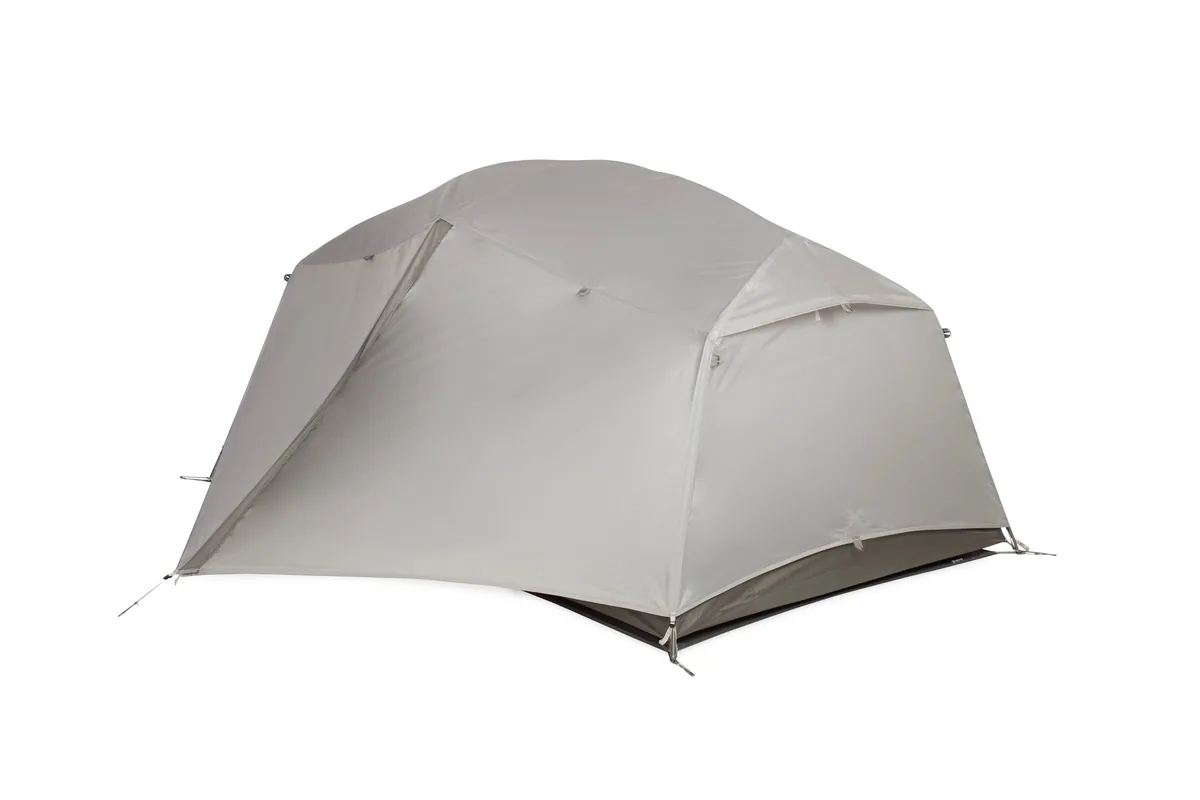
 Backpacking~$300
Nemo
Nemo Aurora
No citable rating — see why we hide some.
Three hundred dollars, footprint included, 32.4 square feet, a 53-inch rectangular floor and a 2000 mm floor rating — the Aurora is the value entry in this catalog and it does not feel like one from the inside. The price of that is 75 ounces, nearly five pounds, in 75D polyester that will outlast the thin stuff by years. Nemo sells it as a bundle with the footprint, which is how a $300 tent ends up cheaper than a $300 tent.
Floor area per person
16.2 sq ft
Standard — 14 to 17 sq ft each — the normal two-pads-and-no-spare-room fit
Weight per person
37.5 oz
from the trail weight of 4 lb 11 oz
Peak height
44 in
Approx. price
~$300
Pads: 26.5 in of floor width each — 2 × 25 in pads fit.
Length: a 88 in floor leaves room for a sleeper up to about 6ft 10in once you allow six inches for a foot box and a pillow.
Best for
A first backpacking tent, or a loaner tent that will get treated badly and survive it.
The size run
One design, 2 capacities. The numbers at the top of this page describe the 2-Person; every size has its own figures below.
| Size | Sleeps | Floor area | Sq ft each | Vestibule | Trail weight | Packed weight | Floor L × W | Approx. price |
|---|---|---|---|---|---|---|---|---|
| 2-Person | 2 | 32.4 sq ft | 16.2 | 18.4 sq ft | 4 lb 11 oz | 5 lb 10 oz | 88 × 53 in | ~$300 |
| 3-Person | 3 | 44.6 sq ft | 14.9 | 18.4 sq ft | 5 lb 12 oz | 6 lb 9 oz | 88 × 73 in | ~$380 |
Specifications
- Type
- Backpacking
- Rated capacity
- 2-person
- Floor area per person(estimated)
- 16.2 sq ft (standard)
- Floor area
- 32.4 sq ft
- Vestibule area
- 18.4 sq ft
- Peak height
- 44 in
- Minimum trail weight
- 4 lb 11 oz
- Packed weight
- 5 lb 10 oz
- Weight per person(estimated)
- 37.5 oz (trail weight)
- Packed size
- 21.5 x 8 x 4 in
- Interior floor width
- 53 in
- Pad fit(estimated)
- 2 × 25 in pads fit
- Fits sleepers up to(estimated)
- 6ft 10in tall
- Doors
- 2
- Vestibules
- 2
- Freestanding
- freestanding
- Poles
- aluminum
- Wall type
- double wall
- Season rating
- 3-season
- Fly fabric
- PU polyester, 2000 mm
- Floor fabric
- 75D recycled PU polyester, 2000 mm
- Floor denier
- 75D
- Floor hydrostatic head
- 2,000 mm
- Approx. price
- ~$300
Features
- Footprint included in the price
- 53 in rectangular floor width, 88 in long
- 2000 mm on both fly and floor
- Two doors, two 9.2 sq ft vestibules
- Nightlight pockets that turn a headlamp into a room light
- Sold in 2 and 3 person, both bundled with the footprint
In its favour
- Two 25 in pads fit side by side on the 53 in rectangular floor
- 2000 mm fly and floor is more waterproofing than tents at twice the price
- Footprint included, which is $60–70 you do not spend later
- 75D polyester floor takes gravel, dogs and careless packing
- 88 in of floor length fits a six-foot sleeper without touching the ends
Against it
- 75 oz is nearly five pounds carried — this is a two-nights-in tent, not a thru-hike tent
- Packs to 21.5 x 8 x 4 in, a real space cost in a 50-litre pack
- Nemo does not publish a peak-height figure for the 3-person
Written from the published specification sheet, not from owner reports.
What owners report
Drawn from archived owner discussions, not from a test of our own.
What owners like
- It comes up constantly on sub-$400 shortlists alongside the Marmot and North Face equivalents, and owners who see it in person rate the interior room
- The materials are a step up from the cheaper rivals — owners specifically note the 75D fabric against the 68D used by tents at the same price
- Headroom is the thing owners mention after seeing it set up next to competitors
- It ships with the footprint, which owners comparing prices against footprint-less rivals point out is a real saving
- It is repeatedly recommended as a three-season tent that will take mountain thunderstorms at this price
Common complaints
- It is at the top end of the budget bracket it competes in, and owners note the price gap against the Marmot and North Face options
- Nearly five pounds for the 2-person is heavy enough that owners buying it for hiking raise the weight directly
- Owners shopping in Europe report the import and tax loading making it much less competitive there
- The 3-person is flagged by prospective owners as possibly too heavy for the use they had in mind
Owners put the Aurora in a specific slot: the best-built tent in the sub-$400 bracket rather than the cheapest one in it. Owners cross-shopping it against the usual budget names put it at the expensive end of the list and justify it on materials — the 75D fabric and the 2000 mm ratings get cited directly against 68D rivals, and the included footprint closes some of the price gap.
What people say after seeing one pitched is that it feels roomy, with better headroom than the alternatives they were considering. That matches the numbers: a 53-inch rectangular floor and 44 inches of peak is a genuinely comfortable two-person shape.
The honest limit is weight. Seventy-five ounces is nearly five pounds, and owners asking whether the 3-person is too heavy for backpacking are asking the right question. This is a tent for weekends, short carries and car camping, and it is a very good one at that job.
Questions people ask about it
Is the Aurora worth more than a Stormbreak or a Tungsten?
Owners who compared them say the Aurora uses heavier fabric — 75D against 68D — and includes the footprint, which narrows the real price gap. Whether that is worth the extra depends on how many nights you expect from it; for a tent that will see a decade, owners say yes.
Can it handle a mountain thunderstorm?
It is recommended for exactly that in the sub-$300 bracket. The 2000 mm fly and floor are higher-rated than most tents at this price, and the freestanding pole structure is stout. It is a three-season tent, not a winter one.
Is it too heavy to backpack with?
At 4 lb 11 oz for the 2-person, split between two people it is fine for a weekend and noticeable on anything longer. Solo it is a lot. Owners buying it for hiking usually mean short approaches rather than long-distance trails.