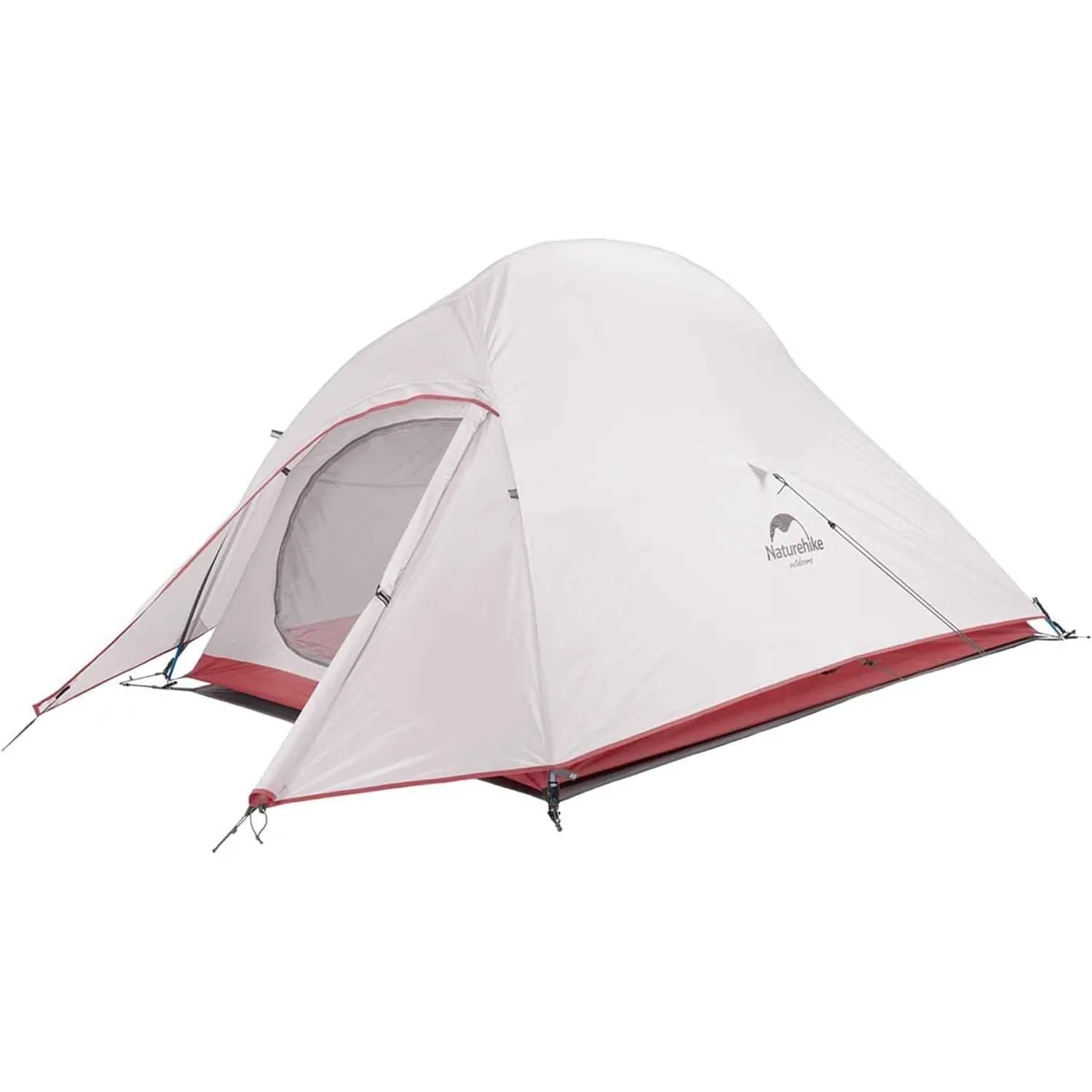
 Backpacking~$164
Naturehike
Naturehike Cloud-Up 2
No citable rating — see why we hide some.
The Cloud-Up is the tent that made Naturehike a name outside China: a 7001-aluminium single-pole double-wall tent at 48.7 ounces and $164, which is ultralight-adjacent weight at budget-tent money. Twenty-eight square feet split two ways is 13.95 each, just under the standard band, and the 82.7-inch floor is the shortest two-person floor in this catalog — a six-foot sleeper touches both ends. Naturehike now sells at least eight Cloud-Up variants; the numbers here are the plain 2-person.
Floor area per person
13.9 sq ft
Tight — under 14 sq ft each — shoulders touching, gear outside
Weight per person
24.4 oz
from the trail weight of 3 lb 1 oz
Peak height
41.3 in
Approx. price
~$164
Pads: 24.6 in of floor width each — 2 × 20 in pads fit, 25 in pads do not.
Length: a 82.7 in floor leaves room for a sleeper up to about 6ft 5in once you allow six inches for a foot box and a pillow.
Best for
A first lightweight tent where the budget will not stretch to a Western brand.
Specifications
- Type
- Backpacking
- Rated capacity
- 2-person
- Floor area per person(estimated)
- 13.9 sq ft (tight)
- Floor area
- 27.9 sq ft
- Peak height
- 41.3 in
- Minimum trail weight
- 3 lb 1 oz
- Packed weight
- 4 lb
- Weight per person(estimated)
- 24.4 oz (trail weight)
- Packed size
- 4.7 x 17.7 in
- Interior floor length
- 82.7 in
- Interior floor width
- 49.2 in
- Pad fit(estimated)
- 2 × 20 in pads fit, 25 in pads do not
- Fits sleepers up to(estimated)
- 6ft 5in tall
- Doors
- 1
- Vestibules
- 1
- Freestanding
- semi-freestanding
- Poles
- aluminum
- Wall type
- double wall
- Season rating
- 3-season
- Approx. price
- ~$164
Features
- 7001-series one-piece aluminium pole
- Double wall with a separate inner
- Packs to 4.7 x 17.7 in
- Sold in 1, 2 and 3 person plus Pro, UL, Base and EXT variants
In its favour
- 48.7 oz at $164 is a weight-to-price ratio nothing Western matches
- Genuine double-wall construction rather than a single-skin shortcut
- 7001 aluminium pole rather than fibreglass
- Packs to 4.7 x 17.7 in
- Packs to 4.7 x 17.7 in, small enough for a 30-litre pack
Against it
- 82.7 in floor length is the shortest two-person floor here — tall sleepers touch both ends
- One door and one vestibule, and Naturehike does not publish the vestibule area
- No published fabric denier or hydrostatic head on the US product page
- Eight near-identically named Cloud-Up variants make it easy to buy the wrong one
Written from the published specification sheet, not from owner reports.
What owners report
Drawn from archived owner discussions, not from a test of our own.
What owners like
- Owners with three years of use on a polyester Cloud Up 2 recommend it highly and without qualification
- One owner rates a Cloud Up 1 at 9.25 out of 10 and keeps it despite owning better tents
- The metal pole structure makes setup easier than the tents owners came from
- It is the default budget recommendation online and owners acknowledge that reputation as earned
- The 20D version of the 3-person is reported as lighter with more space, and an owner using it for a year loves it
Common complaints
- It is tight for two people, which owners report directly and use as the reason to look at the Mongar instead
- Head room and side access are the two things owners want more of when they replace it
- The vestibule on the 1-person is low enough that getting in and out is described as acrobatic
- Corner tears on the inner tent are a reported repair problem
- There are so many Cloud Up variants — Pro, UL, Base, EXT, 20D — that owners struggle to compare them
Ask for a cheap first tent and the Cloud Up is the answer that comes back; the reports from owners who have lived with one are better than the price suggests. Three years on a polyester Cloud Up 2 with a wholehearted recommendation; a Cloud Up 1 rated 9.25 out of 10 by an owner who calls it truly wonderful; a 20D Cloud Up 3 used for a year and loved. That is a consistent record.
The complaints are about space rather than quality. It is tight for two, which owners say plainly and which sends many of them to the Mongar instead. What they want when they replace it is headroom and a side door — the single end entry and the low vestibule are the design's real limits, and on the 1-person getting in and out is described as acrobatic.
The practical trap is the model range. Cloud Up Pro, UL, Base, EXT and a 20D version all exist alongside the standard tent at similar prices, and owners openly struggle to work out which is which. Check the fabric weight and the pole material rather than the name.
Questions people ask about it
Is the Cloud Up 2 big enough for two?
Owners say it is tight, and it is the most common reason they look at the Mongar 2 instead. Twenty-eight square feet on an 82.7-inch floor is a comfortable solo tent and a close two.
Which Cloud Up variant should I buy?
There are Pro, UL, Base, EXT and 20D versions at overlapping prices, and owners find the range genuinely confusing. Compare the fabric denier and the pole material rather than the suffix — the 20D versions are the ones owners rate.
How many seasons does one survive?
Owners report three years of regular use with no complaints, and a Cloud Up 1 still in service alongside better tents. The reported repair problem is tearing at the inner tent corners, which is a fixable failure.
Cloud Up or Mongar?
The Cloud Up is lighter with one door; the Mongar is heavier, freestanding, has two doors and is cheaper. Owners choosing between them for two people generally take the Mongar for the second door.