 Backpacking~$161
Naturehike
Naturehike Mongar 2
No citable rating — see why we hide some.
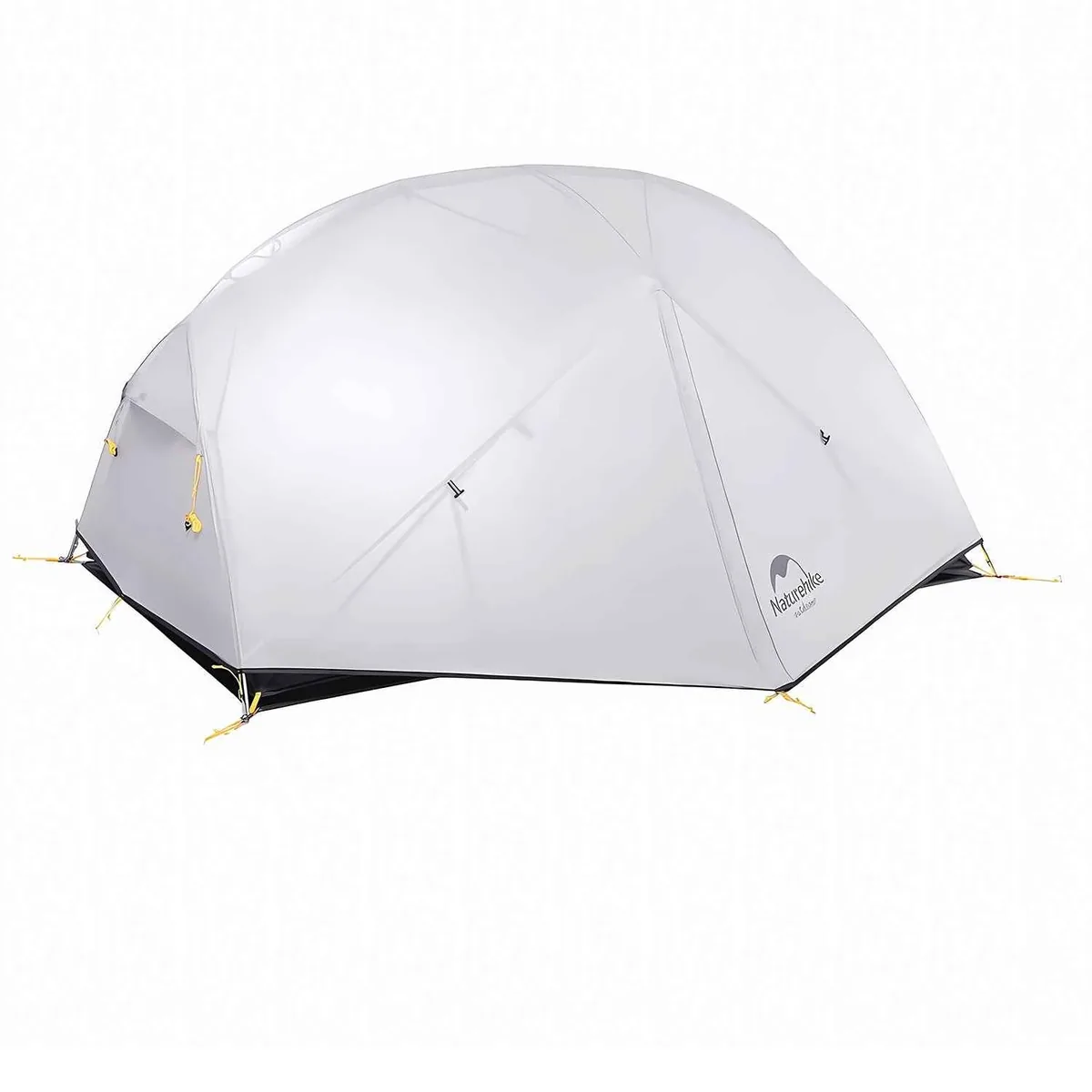
The Mongar is the Cloud-Up's two-door sibling, and the trade is plain: fifteen ounces heavier, two doors instead of one, freestanding instead of semi, and $161 for the 20D nylon version — a heavier 210T polyester version sells for $113. The inner is 82.7 by 53.1 inches, four inches wider than the Cloud-Up's, with 41.3 inches at the peak, and the footprint is in the box. Naturehike publishes no hydrostatic-head rating for either fabric, which is the one gap in its spec sheet, and the 82.7-inch floor carries the same warning for tall sleepers.
Floor area per person
15.3 sq ft
Standard — 14 to 17 sq ft each — the normal two-pads-and-no-spare-room fit
Weight per person
32.1 oz
from the trail weight of 4 lb
Peak height
41.3 in
Approx. price
~$161
Pads: 26.6 in of floor width each — 2 × 25 in pads fit.
Length: a 82.7 in floor leaves room for a sleeper up to about 6ft 5in once you allow six inches for a foot box and a pillow.
Best for
Two people who want their own door on the smallest possible budget.
Specifications
- Type
- Backpacking
- Rated capacity
- 2-person
- Floor area per person(estimated)
- 15.3 sq ft (standard)
- Floor area
- 30.5 sq ft
- Peak height
- 41.3 in
- Weight per person(estimated)
- 32.1 oz (trail weight)
- Packed size
- 5.9 x 19.7 in
- Interior floor length
- 82.7 in
- Interior floor width
- 53.1 in
- Pad fit(estimated)
- 2 × 25 in pads fit
- Fits sleepers up to(estimated)
- 6ft 5in tall
- Doors
- 2
- Vestibules
- 2
- Freestanding
- freestanding
- Poles
- aluminum
- Wall type
- double wall
- Season rating
- 3-season
- Fly fabric
- 20D ripstop nylon
- Floor fabric
- 20D ripstop nylon
- Floor denier
- 20D
- Approx. price
- ~$161
Features
- 20D ripstop nylon; a heavier 210T polyester version sells for $113
- 7001-series aluminium poles
- Freestanding rather than semi-freestanding
- Footprint included
In its favour
- Two doors and two vestibules at a price where every rival gives you one
- 53.1 in interior width takes two 25 in pads, which the Cloud-Up's 49.2 does not
- Freestanding, unlike its Cloud-Up sibling
- Footprint in the box
Against it
- 64.2 oz is four pounds, heavy for a 20D tent
- 82.7 in floor is short for a tall sleeper
- Naturehike does not publish vestibule area
- Naturehike publishes no hydrostatic-head rating for either Mongar fabric
Written from the published specification sheet, not from owner reports.
What owners report
Drawn from archived owner discussions, not from a test of our own.
What owners like
- An owner whose brother pitched a Mongar UL alongside theirs was impressed by what the money buys
- It is repeatedly named alongside the lightest budget options as a legitimately light tent
- Two doors at this price is the reason owners choose it over the Cloud Up
- The awning feature on the UL version is specifically liked by owners
- Owners buy several of them for family groups, which is only possible at this price
Common complaints
- Pole cracking after roughly 20 to 30 setups is reported, and the pole set on the UL is described as having had issues that were later upgraded
- The floor is described as thin by a heavier owner who worries about it
- It is too short for taller owners, who rule it out on that basis
- Owners worry about sand and wind in cold weather and look elsewhere for those conditions
- Colour options are limited, which owners mention when it is otherwise their first choice
The Mongar is the budget tent that gets recommended when somebody wants two doors. At about $160 for the 20D version with a freestanding pole set, it undercuts every Western two-door tent here by well over a hundred dollars, and owners who have seen one pitched next to their own more expensive tent report being impressed by what the money buys.
Poles are the question to take seriously. Owners report cracking after roughly 20 to 30 setups on the UL version, and describe the pole set as having had known issues that were subsequently upgraded — which is reassuring about the current tent and a real warning about a secondhand one. Field repair options for it are something owners ask about specifically, which is not a question you want to be asking.
The other limits are physical. The 82.7-inch floor rules it out for taller owners, and a heavier owner describes the floor as feeling thin. For a light, cheap, two-door tent in fair conditions it is very hard to beat; for cold, sandy or windy ground owners look elsewhere and say so.
Questions people ask about it
Do the poles really crack?
Owners report cracking after roughly 20 to 30 setups on the UL version, and describe the pole set as having had known issues that were later upgraded. Ask which generation you are buying, and carry a splint.
Is the floor tough enough?
A heavier owner describes it as feeling thin and worries about it. It is 20D, which is normal for the weight and thin for the use most budget-tent buyers put it to. Something under it is cheap insurance.
Will a tall person fit?
Not comfortably. The floor is 82.7 inches, which leaves about 6ft 4in once you allow for a foot box and pillow — and owners over six foot rule it out. Look at a tent with an 88-inch floor instead.
Mongar or Cloud Up?
The Mongar has two doors, is freestanding and costs less; the Cloud Up is lighter with one door and a low vestibule. For two people the Mongar's second door is the deciding factor for most owners.