 Backpacking~$610
Slingfin
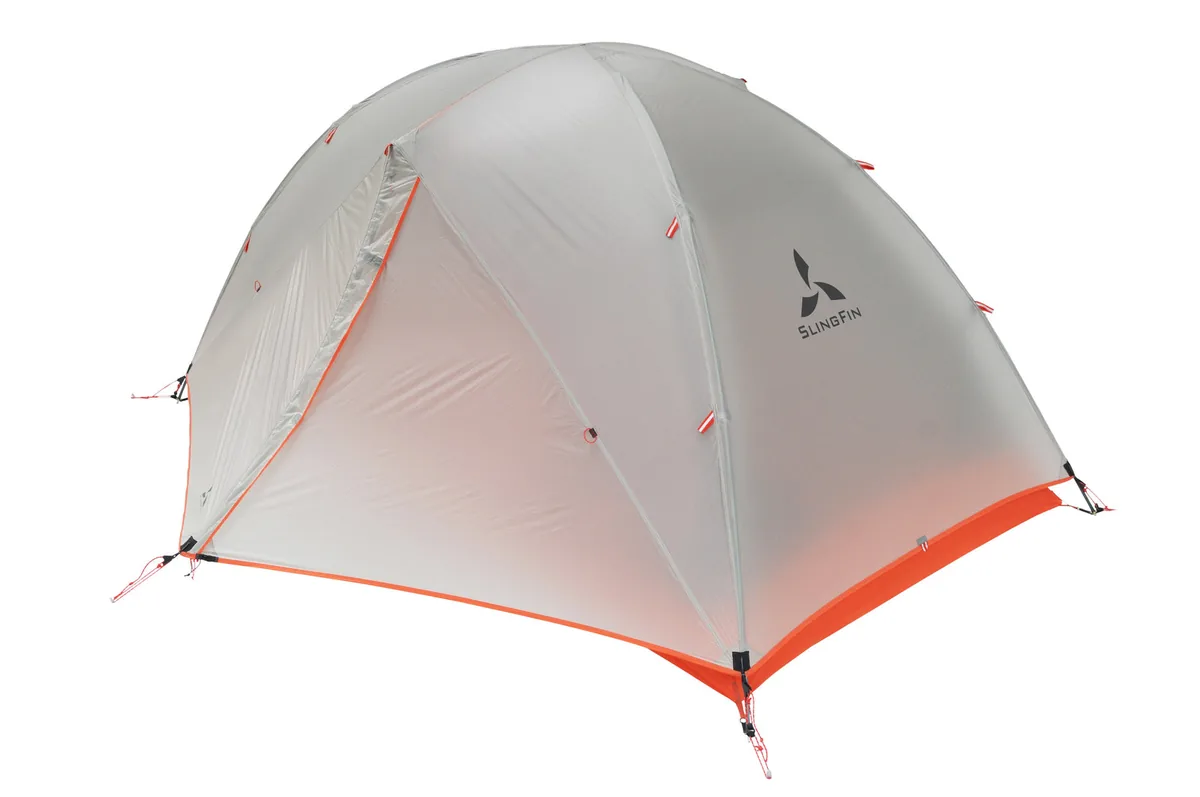
Slingfin Portal 2
No citable rating — see why we hide some.
Slingfin builds tents the way people who have had tents fail in storms build tents: two pre-installed internal guylines for lateral stability, ten external guy points, fly-to-pole toggles, spare zipper sliders already threaded on every zipper, and silicone-impregnated fabric rather than polyurethane so it does not hydrolyse and go sticky in five years. The Portal 2 is 46 ounces for 27.45 square feet, which is not a competitive number on paper — you are paying for the parts of a tent that only matter on the worst night of the trip.
Floor area per person
13.7 sq ft
Tight — under 14 sq ft each — shoulders touching, gear outside
Weight per person
23 oz
from the trail weight of 46 oz
Peak height
44 in
Approx. price
~$610
Best for
Exposed, windy pitches and people who intend to keep the tent for ten years.
Specifications
- Type
- Backpacking
- Rated capacity
- 2-person
- Floor area per person(estimated)
- 13.7 sq ft (tight)
- Floor area
- 27.4 sq ft
- Vestibule area
- 16.8 sq ft
- Peak height
- 44 in
- Minimum trail weight
- 46 oz
- Packed weight
- 3 lb 5 oz
- Weight per person(estimated)
- 23 oz (trail weight)
- Packed size
- 14 x 5 in
- Doors
- 2
- Vestibules
- 2
- Freestanding
- freestanding
- Poles
- DAC aluminum
- Wall type
- double wall
- Season rating
- 3-season
- Fly fabric
- 10D nylon 66 ripstop silicone/silicone, 1200 mm
- Floor fabric
- 20D nylon ripstop silicone/PE, 1800 mm
- Floor denier
- 20D
- Floor hydrostatic head
- 1,800 mm
- Approx. price
- ~$610
Features
- Two pre-installed internal guylines for lateral stability
- Spare zipper sliders pre-threaded on every zipper
- Silicone-impregnated fly and PE floor rather than polyurethane
- Ten external guy points and two perimeter pull-outs
- Pole swivel that joins the long poles for one-piece setup
- Optional 10.65 mm heavy-duty poles and an outrigger that braces it with trekking poles
In its favour
- Internal guylines are a structural feature no other tent here ships with
- Silicone-impregnated fabrics outlast polyurethane coatings by years
- Spare zipper sliders mean the most common tent failure is field-repairable
- Freestanding with 16.8 sq ft of vestibule across two doors
- The heavy-duty pole and outrigger options let one tent cover three seasons and shoulder-season snow
Against it
- 46 oz and 27.45 sq ft is a poor floor-per-ounce figure for the money
- $610 is Copper Spur money for less floor
- Slingfin publishes no interior floor dimensions
- 1200 mm fly is modest given the storm-worthiness the design is built around
Written from the published specification sheet, not from owner reports.
What owners report
Drawn from archived owner discussions, not from a test of our own.
What owners like
- If freestanding matters, owners name it as the best in its weight class for snow and wind
- The optional heavy-duty pole set swaps 8.7 mm poles for 10.65 mm, and owners buying for winter specifically choose it for that
- The outrigger attachment lets you brace it with trekking poles, which owners rate as a genuine structural upgrade
- Owners describe the company as nerdy and scientific and treat that as a reason to trust the engineering
- The cross-pole and trekking-pole prop system gets copied by other brands, which owners notice
- Silicone-impregnated fabrics rather than polyurethane mean it will not hydrolyse and go sticky the way PU flies do
Common complaints
- At around 1,500 g it is heavy for the floor area, and owners looking for lighter freestanding options say so
- It is expensive and hard to find outside the US — owners in Europe and the UK repeatedly report it unavailable
- The mesh inner puts some owners off for cold or dusty conditions, and there is no solid-inner option in the discussion
- Owners ask specifically whether sand and snow get in through the mesh and the gap at the bottom, and nobody answers
Slingfin's reputation among owners is unusual: people trust the company's engineering as much as the product. The description that comes up is nerdy and scientific, and owners point at the details — internal guylines, spare zipper sliders pre-threaded, silicone-impregnated fabrics rather than polyurethane — as evidence that somebody thought about what actually fails.
The Portal's specific draw is that it is freestanding and it can be upgraded. When owners want a freestanding tent for snow and wind, this is the name that comes up, and the reason is the optional 10.65 mm pole set and the outrigger attachment that lets trekking poles brace the structure. That is a purchase path nobody else offers at this weight.
Weight, price and availability are what it costs you. Twenty-seven square feet for 46 ounces is not a competitive number on paper, it is expensive, and owners outside the US report simply not being able to buy one. The mesh inner also puts off owners planning on sand or spindrift, and the question of what gets through it is asked and never answered.
Questions people ask about it
Why is it worth more than a lighter tent with the same floor area?
You are paying for the things that fail. Internal guylines that brace the tent from inside, spare zipper sliders already threaded on every zip, ten external guy points, and silicone-impregnated fabric that will not hydrolyse the way polyurethane coatings do after a few years.
Is it good enough for winter?
Owners name it as the best freestanding option in its weight class for snow and wind, particularly with the heavy-duty 10.65 mm pole set and the outrigger that braces it with trekking poles. It is not a four-season tent, but it is the three-season tent people take into shoulder-season snow.
Does sand or snow blow in through the mesh?
Owners ask this directly and nobody in the discussion answers it. The inner is mesh with a gap at the bottom, which is a normal three-season arrangement and a known weakness in blowing sand or spindrift.
Can I buy one outside the US?
With difficulty. Owners in the UK and Europe repeatedly report it unavailable through local retailers, which is the most common reason they end up with something else.