 Family cabin~$650
Big Agnes
Big Agnes Bunk House
No citable rating — see why we hide some.
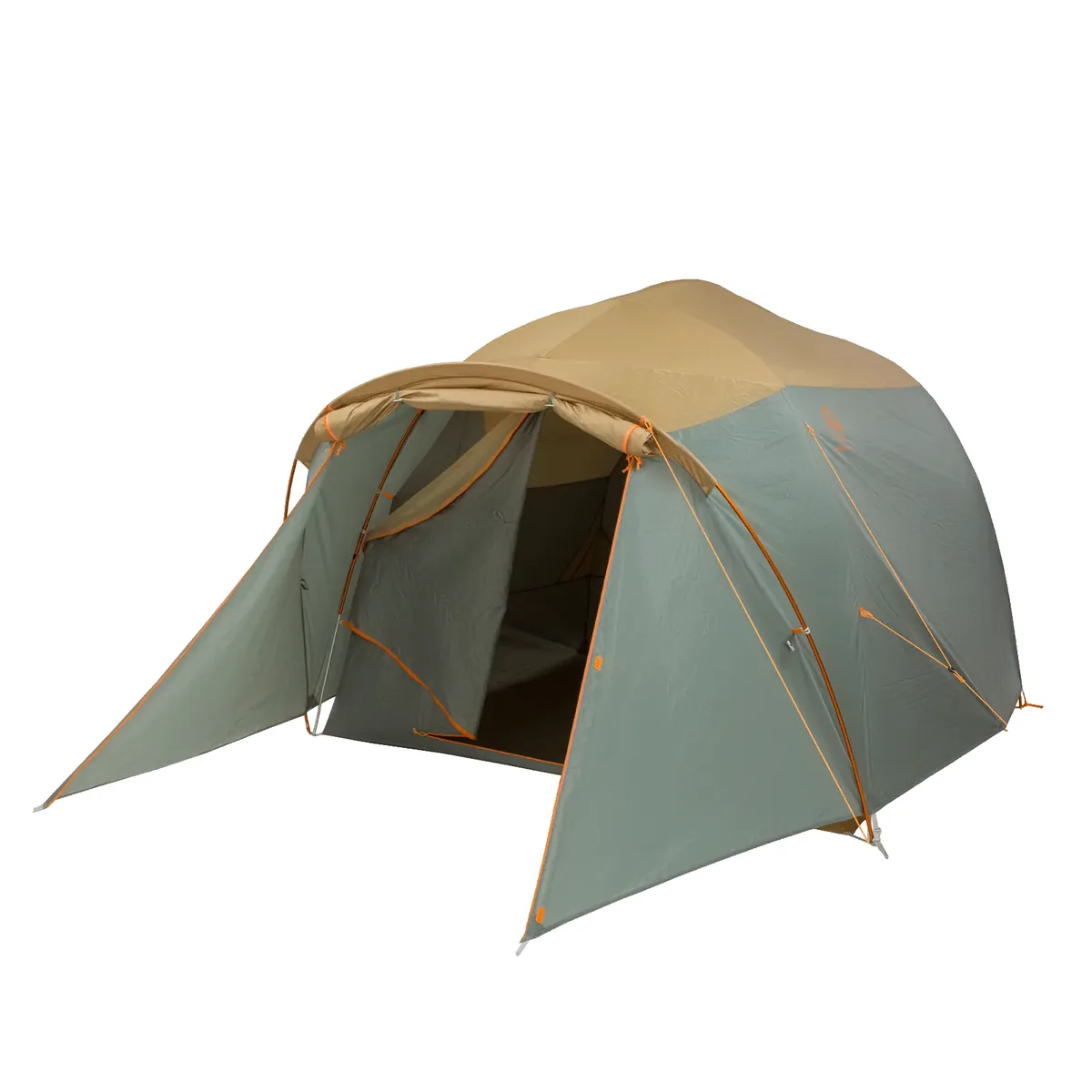
The Bunk House is the Big House with the weather protection added back: same 58-square-foot floor and stand-up height, plus a 34-square-foot covered vestibule on one side, 15 on the other, and a 23-square-foot awning over the door. Total covered area comes to more than the floor. It weighs fourteen pounds in the 4-person size, which is a lot even for a car tent, and it costs $100 more than the Big House — both of which buy you the ability to cook, change and sit outside in rain.
Floor area per person
14.5 sq ft
Standard — 14 to 17 sq ft each — the normal two-pads-and-no-spare-room fit
Weight per person
3 lb 8 oz
from the trail weight of 14 lb
Peak height
72 in
Approx. price
~$650
Pads: 22.5 in of floor width each — 4 × 20 in pads fit, 25 in pads do not.
Length: a 92 in floor leaves room for a sleeper up to about 7ft 2in once you allow six inches for a foot box and a pillow.
Best for
Family camping in genuinely wet places, where the covered area matters as much as the sleeping area.
The size run
One design, 2 capacities. The numbers at the top of this page describe the Bunk House 4; every size has its own figures below.
| Size | Sleeps | Floor area | Sq ft each | Vestibule | Trail weight | Packed weight | Floor L × W | Approx. price |
|---|---|---|---|---|---|---|---|---|
| Bunk House 4 | 4 | 58 sq ft | 14.5 | 49 sq ft | 14 lb | 15 lb | 92 × 90 in | ~$650 |
| Bunk House 6 | 6 | 82 sq ft | 13.7 | 56 sq ft | 17 lb | 18 lb 4 oz | 118 × 100 in | ~$750 |
Specifications
- Type
- Family cabin
- Rated capacity
- 4-person
- Floor area per person(estimated)
- 14.5 sq ft (standard)
- Floor area
- 58 sq ft
- Vestibule area
- 49 sq ft
- Peak height
- 72 in
- Minimum trail weight
- 14 lb
- Packed weight
- 15 lb
- Weight per person(estimated)
- 3 lb 8 oz (trail weight)
- Packed size
- 6 x 16.5 x 26.5 in
- Interior floor width
- 90 in
- Pad fit(estimated)
- 4 × 20 in pads fit, 25 in pads do not
- Fits sleepers up to(estimated)
- 7ft 2in tall
- Doors
- 2
- Vestibules
- 2
- Freestanding
- freestanding
- Poles
- aluminum
- Wall type
- double wall
- Season rating
- 3-season
- Fly fabric
- 75D polyester taffeta, 1500 mm polyurethane, no intentionally added PFAS
- Floor fabric
- 75D polyester taffeta, 1500 mm polyurethane, no intentionally added PFAS
- Floor denier
- 75D
- Floor hydrostatic head
- 1,500 mm
- PFAS-free treatment
- stated PFAS-free
- Approx. price
- ~$650
Features
- 34 sq ft + 15 sq ft vestibules plus a 23 sq ft door awning
- 72 in (4P) and 78 in (6P) peak heights
- PFAS-free 75D polyester taffeta throughout
- Removable room divider in the 6-person
- Same inner footprint as the Big House
In its favour
- More covered outdoor space than any other tent in this catalog
- Stand-up height plus a real porch, which is the pairing most cabin tents miss
- PFAS-free 75D fabric on fly and floor
- Shares the Big House inner dimensions, so the same footprint fits
Against it
- Fourteen pounds for the 4-person and seventeen for the 6-person
- $650 before you have bought a footprint
- All that vestibule needs guylines and open ground — it is a poor fit for a tight forest pitch
Written from the published specification sheet, not from owner reports.
What owners report
Drawn from archived owner discussions, not from a test of our own.
What owners like
- The vestibule is what sells it — owners pick it over rivals specifically for the covered, dry space at the door
- The awning-and-shelter mode is named as a genuine feature rather than a gimmick, useful on dry days and for cooking
- Materials and build are described as a step up from the cheaper family tents people cross-shop it against
- The footprint is easy to get hold of, which owners raise as a real advantage over rivals whose accessories are discontinued
- The room divider and the organised carry pack both get specific praise from owners choosing between big cabin tents
- Big Agnes has honoured warranty claims with substantial store credit, according to one owner working through a replacement
Common complaints
- There are no vents in the rainfly, and owners worry openly about heat with both vestibules closed on a summer night
- Setup is better with two people — owners consistently say so, and it is a heavy tent to wrestle alone
- The MSRP is the most common objection, with owners describing it as too expensive next to comparable cabins
- There is no mesh in some configurations, which compounds the ventilation worry in hot weather
- Version confusion is real: owners report bags labelled differently from the tent inside, and older vestibules not matching newer pole layouts
People buy the Bunk House for its porch. Owners comparing big cabin tents keep landing on it for the same reason — a genuinely large covered vestibule with a brow over the door that lets you sit with the fly open and still see out in light rain. Alongside that they rate the materials over the cheaper cabins and, unusually, the carry pack.
Ventilation is the standing worry. The rainfly has no dedicated vents, and prospective owners raise the same question repeatedly: what happens in July with both vestibules shut. Nobody in the discussion reports it being unbearable, but nobody reassures them either, and it is the one thing to think about if your camping is hot rather than wet.
Practical notes: plan on two people to pitch it, and check which generation you are buying. Owners report label mismatches between bag and tent, and vestibule accessories from one year not fitting another year's pole layout. The 1500 mm floor rating also gets questioned — it is adequate but it is not generous for a tent this size.
Questions people ask about it
Is the Bunk House hot in summer?
It is the most-raised concern, because the rainfly has no dedicated vents. With the vestibule doors open it is fine; with both closed on a warm night owners expect it to be stuffy. If your camping is hot and dry rather than wet, a tent with fly vents is a better match.
Can one person set it up?
Yes, but everybody who has done it says it is better with two. The 4-person is 14 lb and the 6-person is 17, and the vestibule poles want a second pair of hands. Arriving after dark alone is where people notice.
Is the 1500 mm floor enough?
Owners ask this directly. Fifteen hundred millimetres is on the low side for a big tent that will sit on damp ground for several nights with people kneeling on it. A groundsheet under it is cheap insurance and most owners run one.
Bunk House or Marmot Limestone?
Owners who compared them line it up as: the Bunk House has the larger vestibules, a divider, zippered door windows and shelter mode; the Limestone has fly vents and an awning you prop with hiking poles. The deciding factors are ventilation on one side and covered space on the other.