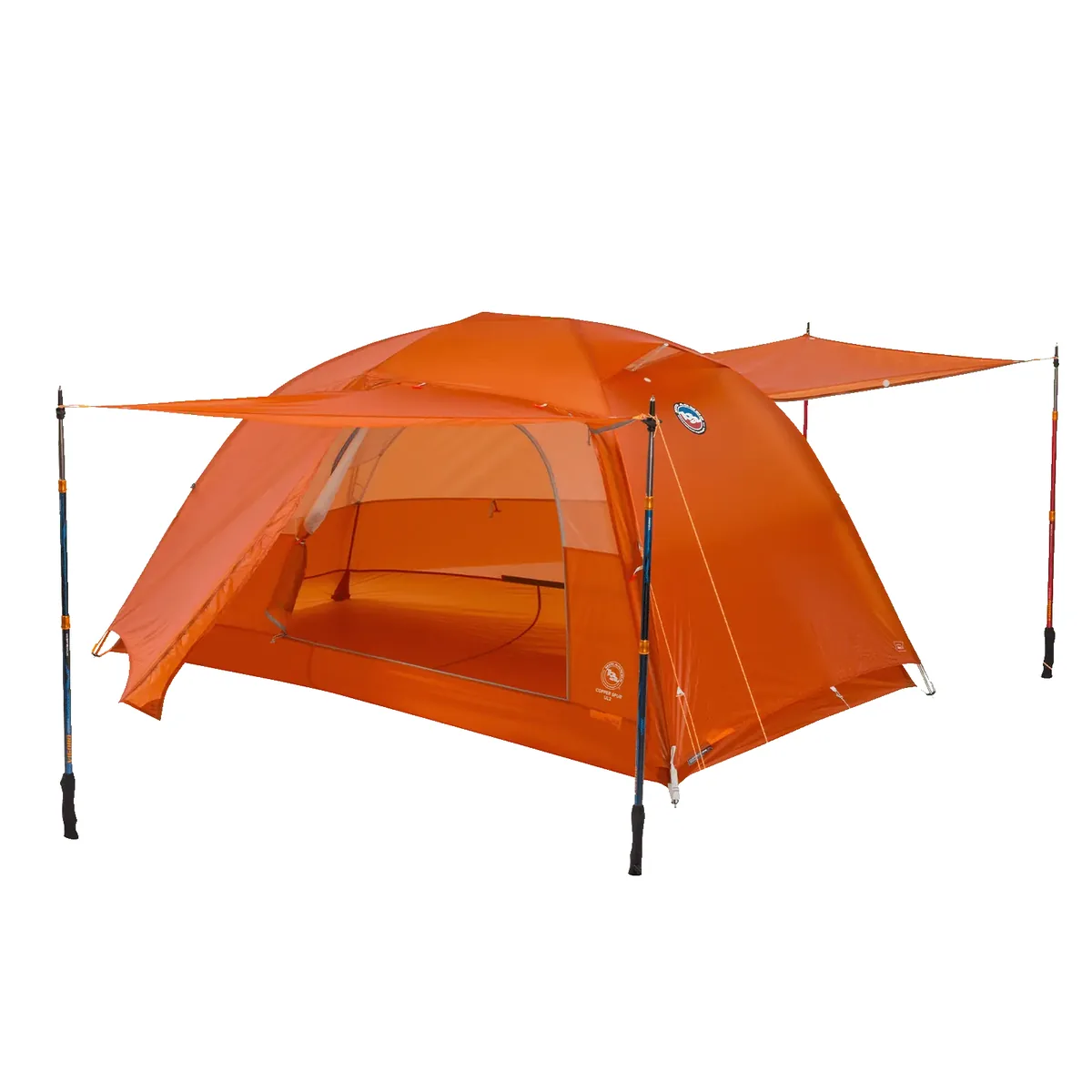
 Ultralight~$600
Big Agnes
Big Agnes Copper Spur UL
No citable rating — see why we hide some.
The Copper Spur is the tent most people picture when they picture a light freestanding backpacking tent, and the reason is the shape: steeply pitched walls carried on a DAC hubbed pole set, so the 29 square feet inside the UL2 is usable floor rather than floor that tapers into the fly. Two doors, two nine-square-foot vestibules and 40 inches of head height put it squarely in the comfort half of the ultralight class, and it still comes in at 42 ounces packed for the trail. What you pay for that is money and fabric: the 15D/20D HyperBead canopy is thin enough that the footprint stops being optional on granite or desert grit, and $600 is a lot of tent. The UL1 through UL4 all share the geometry, so picking a size here is genuinely picking a size and not a different tent.
Floor area per person
14.5 sq ft
Standard — 14 to 17 sq ft each — the normal two-pads-and-no-spare-room fit
Weight per person
21 oz
from the trail weight of 42 oz
Peak height
40 in
Approx. price
~$600
Pads: 26.0 in of floor width each — 2 × 25 in pads fit.
Length: a 88 in floor leaves room for a sleeper up to about 6ft 10in once you allow six inches for a foot box and a pillow.
Best for
Two backpackers who want a genuinely liveable freestanding tent and will accept thin fabric and a high price to get it under three pounds.
The size run
One design, 4 capacities. The numbers at the top of this page describe the UL2; every size has its own figures below.
| Size | Sleeps | Floor area | Sq ft each | Vestibule | Trail weight | Packed weight | Floor L × W | Approx. price |
|---|---|---|---|---|---|---|---|---|
| UL1 | 1 | 20 sq ft | 20.0 | 9 sq ft | 32 oz | 38 oz | 88 × 38 in | ~$500 |
| UL2 | 2 | 29 sq ft | 14.5 | 18 sq ft | 42 oz | 3 lb | 88 × 52 in | ~$600 |
| UL3 | 3 | 41 sq ft | 13.7 | 18 sq ft | 3 lb 6 oz | 3 lb 13 oz | 90 × 70 in | ~$650 |
| UL4 | 4 | 57 sq ft | 14.3 | 28 sq ft | 5 lb | 5 lb 8 oz | 86 × 96 in | ~$850 |
Specifications
- Type
- Ultralight
- Rated capacity
- 2-person
- Floor area per person(estimated)
- 14.5 sq ft (standard)
- Floor area
- 29 sq ft
- Vestibule area
- 18 sq ft
- Peak height
- 40 in
- Minimum trail weight
- 42 oz
- Packed weight
- 3 lb
- Weight per person(estimated)
- 21 oz (trail weight)
- Packed size
- 19.5 x 4 in
- Interior floor width
- 52 in
- Pad fit(estimated)
- 2 × 25 in pads fit
- Fits sleepers up to(estimated)
- 6ft 10in tall
- Doors
- 2
- Vestibules
- 2
- Freestanding
- freestanding
- Poles
- DAC aluminum
- Wall type
- double wall
- Season rating
- 3-season
- Fly fabric
- HyperBead 15D nylon with 20D solution-dyed ripstop, 1500 mm
- Floor fabric
- HyperBead 15D nylon with 20D solution-dyed ripstop, 1500 mm
- Floor denier
- 20D
- Floor hydrostatic head
- 1,500 mm
- Approx. price
- ~$600
Features
- Hubbed DAC Featherlite NFL/NSL pole set with a steep-wall geometry
- Two doors and two 9 sq ft vestibules with awning-style rollback
- Fly-and-footprint fast pitch at 34 oz without the inner
- Media pockets and an overhead gear ceiling in every size
- Solution-dyed fabric, which holds colour and UV resistance longer than piece-dyed
- Sold in UL1 through UL4, plus XL and bikepack variants of the same geometry
In its favour
- Steep walls mean the quoted 29 sq ft is mostly usable, not tapered dead space
- Two doors and two vestibules — nobody climbs over anybody at 2am
- 42 oz trail weight is competitive with semi-freestanding rivals that give you less room
- Freestanding, so it pitches on tent pads, rock slabs and shelter platforms
- The same design runs UL1 to UL4, so a solo hiker can buy the roomy version of a known quantity
- Solution-dyed fabric holds its colour and UV resistance longer than piece-dyed nylon
Against it
- $600 for the UL2 is at the top of the freestanding market
- 15D/20D canopy and floor want a footprint on anything abrasive
- Big Agnes dropped the HV from the name in the current generation, which makes older reviews confusing to match up
- The UL4's peak height is not published, so the family's headroom claim only covers UL1 to UL3
Written from the published specification sheet, not from owner reports.
What owners report
Drawn from archived owner discussions, not from a test of our own.
What owners like
- Long service lives are the recurring theme — owners describe five years and several hundred nights on one tent and still rate it
- It has ridden out real wind: multiple accounts of gusty nights where the tent held up with all the guylines out
- Two people can put it up without discussion, which owners repeatedly name as the reason it worked for a partner's first backpacking trip
- The UL3 is widely treated as the correct two-person tent — the extra floor is the most-recommended upgrade in the line
- Steep door walls come up in comparisons as the thing that makes its vestibules feel bigger than the square footage suggests
Common complaints
- The UL2 is reported as genuinely tight for two, and it will not take two wide pads
- Leaks on a first outing turn up more than once, on tents pitched and staked correctly
- Zippers are a standing complaint across the Big Agnes ultralight line; owners who have used other brands describe the difference as obvious
- Small plastic pole hardware breaking is a recurring repair question, and getting the part is the hard half
- At full price it is hard to justify against siblings that are lighter and hundreds of dollars cheaper, and owners say so plainly
The Copper Spur is the default answer in this category and the discussion reflects that: a lot of people own one, most of them like it, and the complaints are specific rather than general. The recurring praise is durability over years rather than any single feature — several owners describe half a decade of use and still recommend it. The recurring criticism is that the UL2 is a tight two, which matches the arithmetic: 29 square feet split two ways is 14.5 each, right on the line between tight and standard.
Owners' practical advice to each other is to buy one size up. The UL3 comes up again and again as the tent that is actually right for two adults, and it is the same design, the same fabric and the same pitch for 12 more ounces. Owners with dogs land there even faster.
Two things spoil the record. Zippers get named as the weak point often enough to be a pattern rather than bad luck, and a handful of owners report a leak on a properly pitched tent within the first few nights. Neither is universal, and Big Agnes's warranty handling is not a common complaint — but neither is the kind of thing you expect at this price.
Questions people ask about it
Is the Copper Spur UL2 big enough for two people?
It sleeps two and it is tight doing it. Twenty-nine square feet is 14.5 per person, the floor tapers from 52 inches at the head to 42 at the foot, and owners consistently report that two wide pads do not fit. As a roomy solo tent it is excellent; for two adults who want any spare floor, the UL3 is the version people end up recommending.
Do I need a footprint with it?
On grass, no. On grit, granite or desert ground, yes — the canopy and floor are 15D/20D and owners who camp on rough surfaces treat a groundsheet as standard. Plenty use a cut sheet of polycryo rather than the branded footprint, which saves four ounces and about sixty dollars.
How much wind will it take with every guyline out?
Better than its weight suggests, provided every guyline is out. Accounts of gusty nights where it held up are common; accounts of it failing are not. The failures that do get described tend to involve pegs pulling out of soft ground rather than the tent itself giving way.
Why is the HV missing from the name now?
Big Agnes dropped the HV designation from the current generation, which also moved to their HyperBead fabric. Older reviews and listings for the Copper Spur HV UL2 are describing the same tent family, which makes secondhand shopping confusing — check the fabric description rather than the name.
Copper Spur or Tiger Wall?
The Tiger Wall saves seven ounces and $100 by giving up the rear pole, which makes it semi-freestanding and one square foot smaller. Owners who have had both describe the Copper Spur as the more substantial tent and the Tiger Wall as the one they take when weight is the point.