 Ultralight~$550
Nemo
Nemo Dragonfly OSMO
No citable rating — see why we hide some.
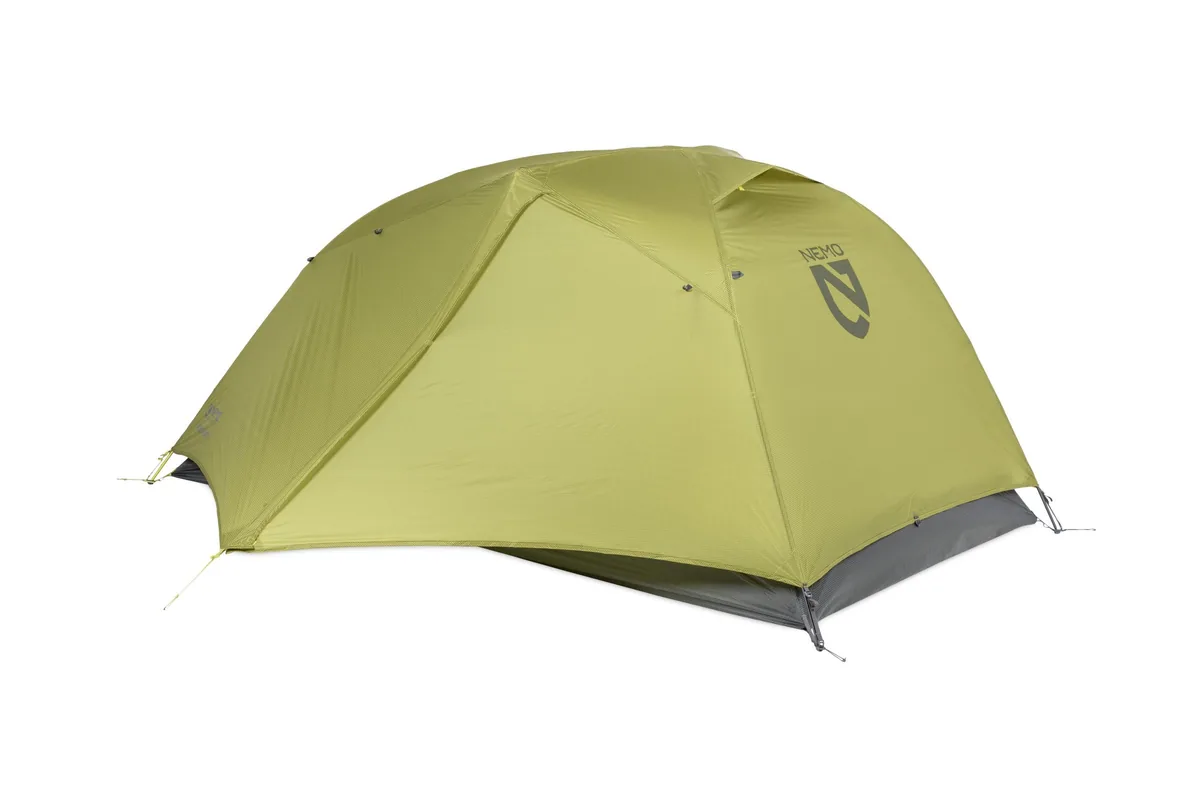
The Dragonfly is the freestanding middle of the Nemo line: 45 ounces, 29 square feet, two doors, 17 square feet of vestibule, and — unlike the Hornet — a pole structure that stands on its own. It is eight ounces lighter than the Dagger and gives up a square foot and a half of floor plus most of the Dagger's rectangular width, tapering from 50 inches at the head to 45 at the foot. That taper is the decision: if you both use 25-inch pads, the Dagger; if one of you is on a 20, the Dragonfly saves half a pound.
Floor area per person
14.5 sq ft
Standard — 14 to 17 sq ft each — the normal two-pads-and-no-spare-room fit
Weight per person
22.5 oz
from the trail weight of 45 oz
Peak height
40 in
Approx. price
~$550
Pads: 25.0 in of floor width each — 2 × 25 in pads fit.
Length: a 88 in floor leaves room for a sleeper up to about 6ft 10in once you allow six inches for a foot box and a pillow.
Best for
A pair who want freestanding convenience without the Dagger's extra half pound.
The size run
One design, 3 capacities. The numbers at the top of this page describe the 2-Person; every size has its own figures below.
| Size | Sleeps | Floor area | Sq ft each | Vestibule | Trail weight | Packed weight | Floor L × W | Approx. price |
|---|---|---|---|---|---|---|---|---|
| 1-Person | 1 | 20.5 sq ft | 20.5 | 8.6 sq ft | 35 oz | 44 oz | 88 × 35 in | ~$500 |
| 2-Person | 2 | 29 sq ft | 14.5 | 17.2 sq ft | 45 oz | 3 lb 6 oz | 88 × 50 in | ~$550 |
| 3-Person | 3 | 41.2 sq ft | 13.7 | 17.2 sq ft | 3 lb 6 oz | 3 lb 15 oz | 88 × 70 in | ~$620 |
Specifications
- Type
- Ultralight
- Rated capacity
- 2-person
- Floor area per person(estimated)
- 14.5 sq ft (standard)
- Floor area
- 29 sq ft
- Vestibule area
- 17.2 sq ft
- Peak height
- 40 in
- Minimum trail weight
- 45 oz
- Packed weight
- 3 lb 6 oz
- Weight per person(estimated)
- 22.5 oz (trail weight)
- Packed size
- 20.5 x 6 x 3 in
- Interior floor width
- 50 in
- Pad fit(estimated)
- 2 × 25 in pads fit
- Fits sleepers up to(estimated)
- 6ft 10in tall
- Doors
- 2
- Vestibules
- 2
- Freestanding
- freestanding
- Poles
- aluminum
- Wall type
- double wall
- Season rating
- 3-season
- Fly fabric
- OSMO ripstop, 1500 mm
- Floor fabric
- OSMO ripstop, 1500 mm
- Floor hydrostatic head
- 1,500 mm
- Approx. price
- ~$550
Features
- Freestanding at 45 oz with two doors and two vestibules
- Landing Zone tub and Nightlight pockets that diffuse a headlamp
- OSMO recycled fly and floor at 1500 mm
- Fly-first pitch option for wet setups
- Available in 1, 2 and 3 person on one geometry
In its favour
- Genuinely freestanding at a weight where most rivals are semi-freestanding
- Eight ounces lighter than the Dagger for only 1.6 sq ft less floor
- 1500 mm on both fly and floor, higher than either Hornet
- Fly-first pitch keeps the inner dry when you set up in rain
Against it
- Floor tapers to 45 in, so two 25 in pads will overlap at the foot
- 45 oz is no longer light next to trekking-pole shelters at half that
- The 1-person at 35 oz is heavier than plenty of 2-person tents here
Written from the published specification sheet, not from owner reports.
What owners report
Drawn from archived owner discussions, not from a test of our own.
What owners like
- Owners who bought both a Hornet and a Dragonfly describe the Dragonfly as noticeably sturdier and more spacious
- OSMO fabric is widely considered the more durable of Nemo's options, and owners cite that as the reason to pick it over lighter rivals
- It sits between the Hornet and the Dagger in a way owners find genuinely useful — the middle option that people actually want
- The 20D floor is thicker than several direct rivals, and owners raise that against 15D tents when deciding whether to carry a footprint
- Heavy discounting is common, and owners repeatedly report picking up a 2P for well under half price
Common complaints
- It is heavy for what it is — owners describe the 2P as a comparatively heavy tent for an ultralight-marketed design
- The pole joints are reported as thin-walled on the 1P, which worries owners handling them
- Replacement poles and splints are hard to identify and source, judging by how often owners ask for the sizes
- Even with the 20D floor, owners say it feels thin enough to want a groundsheet, which puts the weight back
The Dragonfly is the tent people land on after cross-shopping the Hornet and the Dagger, and the owners who have handled all three are consistent about where it sits: sturdier and roomier than the Hornet, half a pound lighter and slightly narrower than the Dagger. One owner who bought both a Hornet and a Dragonfly secondhand at similar prices concluded the Dragonfly was worth the small weight penalty for the extra space and stability.
The fabric is the other reason people choose it. OSMO gets a better durability reputation than the thinner nylons, and the 20D floor is specifically compared against 15D rivals when owners are deciding whether they need a footprint — though several conclude they want one anyway, which eats the weight advantage.
The complaints are mechanical rather than structural. Pole joints on the 1P are described as thin, and finding a replacement section or the right splint size is a recurring question, which suggests Nemo's spares are not easy to navigate. Nobody reports the tent failing; they report not being able to fix it quickly when a part goes missing.
Questions people ask about it
Dragonfly or Hornet?
An owner who bought both at similar secondhand prices described the Dragonfly as significantly more sturdy and spacious for a small weight penalty. The Hornet is semi-freestanding and packs smaller; the Dragonfly is freestanding and has more usable volume.
Is the 20D floor thick enough to skip a footprint?
It is thicker than the 15D floors it competes against, but owners still describe it as feeling thin on rough ground. On grass, skip it. On grit or granite, put something under it — and note that the moment you do, the weight gap to a tougher tent narrows.
Is it good in rain and wind?
Owners buying for wet, windy conditions are generally pointed at it favourably over the Hornet, which is the weaker of the two in wind. It is not a four-season tent, but the full-coverage fly and freestanding pole structure handle three-season weather.
How hard is it to get replacement parts?
Harder than it should be. Owners who have lost a pole section or need a splint size routinely have to ask rather than look it up, and the 1P's pole joints in particular are described as thin-walled. Worth knowing before a long trip.