 Ultralight~$450
Big Agnes
Big Agnes Fly Creek UL
No citable rating — see why we hide some.
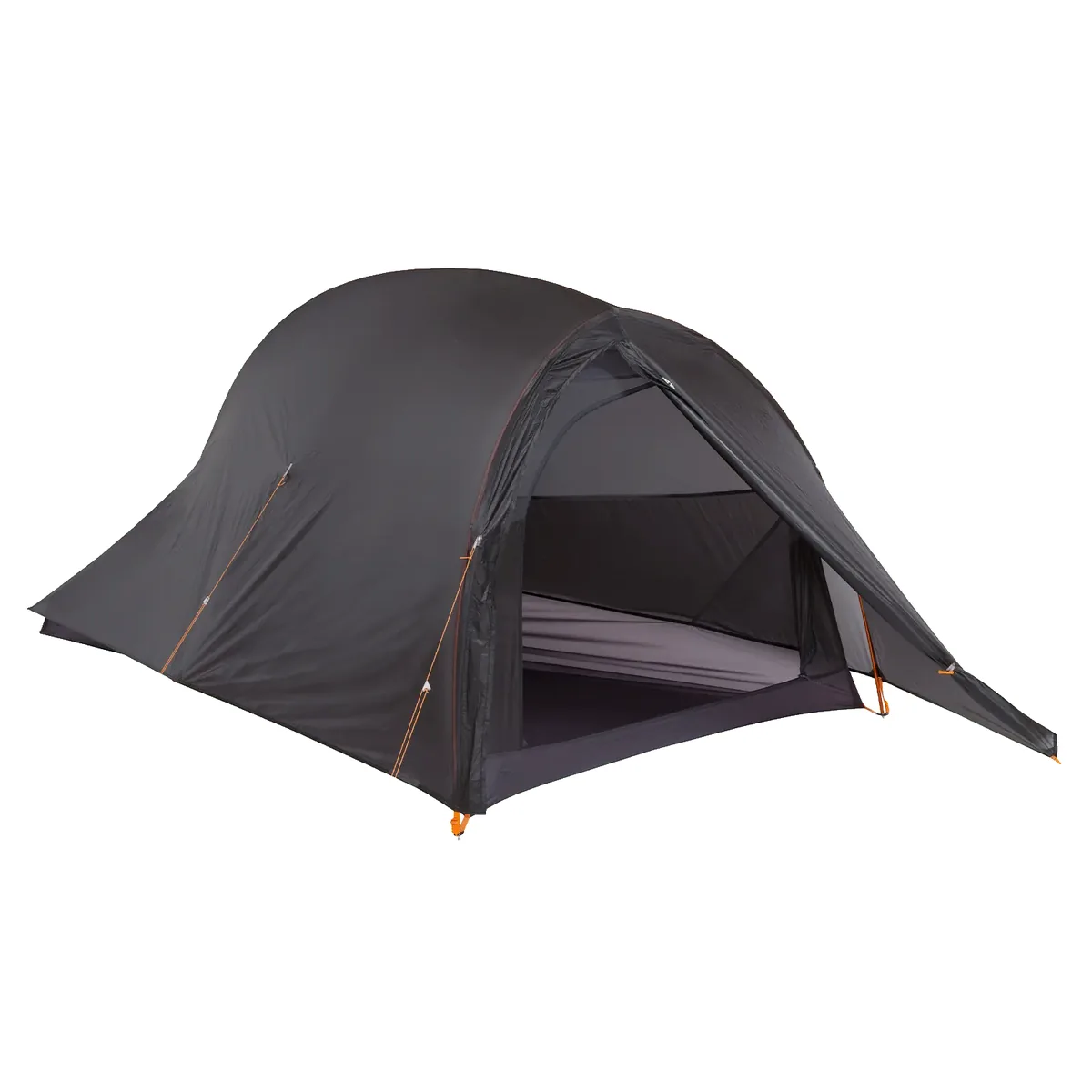
The Fly Creek is the cheapest way into a 30-ounce double-wall tent, and the saving is paid for in one place: the door. There is one, at the head end, so the person sleeping on the far side crawls over their partner to get out, and the single vestibule is eight square feet of gear space for two people's boots and packs. Everything else is the familiar Big Agnes recipe — hubbed DAC pole, 15D recycled ripstop, 42 inches of head height, semi-freestanding foot corners. As a solo tent it is excellent value; as a two-person tent it is a tent for couples who are genuinely relaxed about climbing over each other.
Floor area per person
14.0 sq ft
Standard — 14 to 17 sq ft each — the normal two-pads-and-no-spare-room fit
Weight per person
15 oz
from the trail weight of 30 oz
Peak height
42 in
Approx. price
~$450
Pads: 26.0 in of floor width each — 2 × 25 in pads fit.
Length: a 86 in floor leaves room for a sleeper up to about 6ft 8in once you allow six inches for a foot box and a pillow.
Best for
A solo hiker who wants the 2-person floor to sprawl in, or a couple who does not mind a single door.
The size run
One design, 2 capacities. The numbers at the top of this page describe the UL2; every size has its own figures below.
| Size | Sleeps | Floor area | Sq ft each | Vestibule | Trail weight | Packed weight | Floor L × W | Approx. price |
|---|---|---|---|---|---|---|---|---|
| UL1 | 1 | 20 sq ft | 20.0 | 5 sq ft | 27 oz | 32 oz | 86 × 38 in | ~$420 |
| UL2 | 2 | 28 sq ft | 14.0 | 8 sq ft | 30 oz | 36 oz | 86 × 52 in | ~$450 |
Specifications
- Type
- Ultralight
- Rated capacity
- 2-person
- Floor area per person(estimated)
- 14.0 sq ft (standard)
- Floor area
- 28 sq ft
- Vestibule area
- 8 sq ft
- Peak height
- 42 in
- Minimum trail weight
- 30 oz
- Packed weight
- 36 oz
- Weight per person(estimated)
- 15 oz (trail weight)
- Packed size
- 19 x 6 in
- Interior floor width
- 52 in
- Pad fit(estimated)
- 2 × 25 in pads fit
- Fits sleepers up to(estimated)
- 6ft 8in tall
- Doors
- 1
- Vestibules
- 1
- Freestanding
- semi-freestanding
- Poles
- DAC aluminum
- Wall type
- double wall
- Season rating
- 3-season
- Fly fabric
- Recycled 15D nylon ripstop
- Floor fabric
- Recycled 15D nylon ripstop
- Floor denier
- 15D
- Approx. price
- ~$450
Features
- Single head-end door with a steep entry
- One 8 sq ft vestibule (5 sq ft on the UL1)
- Hubbed DAC pole with a foot spreader bar
- Recycled 15D ripstop fly, floor and canopy
In its favour
- 30 oz trail weight for a true double-wall tent with a bathtub floor
- $450 undercuts every other 2-person double-wall tent this light
- 42 in head height at the door end is generous for the weight
- Sold in a 1-person size at 27 oz, which is the lightest freestanding-ish solo tent Big Agnes makes
- Packs to 19 x 6 in, small enough to sit inside a 40-litre pack rather than on it
Against it
- One door: the inside sleeper climbs over the outside sleeper, every time
- 8 sq ft of vestibule is tight for two packs and two pairs of boots
- Steeply tapered foot end — a 25 in pad is snug at the far end
- Semi-freestanding, so stakes are not optional
Written from the published specification sheet, not from owner reports.
What owners report
Drawn from archived owner discussions, not from a test of our own.
What owners like
- At 30 oz for the 2-person it undercuts a lot of shelters that call themselves ultralight once their poles are counted
- Owners report it handling wind well for its weight, and being easier to pitch low than a taller tent
- It appears consistently on thru-hiking gear surveys, so its record is long rather than theoretical
- Semi-freestanding in a way owners say they barely notice — several report never staking it out unless it might blow away
- It is hundreds of dollars cheaper than the Copper Spur, which owners raise directly when asked why anyone buys the more expensive one
Common complaints
- The single head-end door is the complaint: owners describe it getting old fast, and a 6ft 3in owner describes struggling to get through it
- One pole failure is recorded even with all guylines out, in conditions another tent nearby survived
- Pole hardware coming apart — the plastic fitting at the hub — is a recurring repair question
- Owners report the inner sticking out beyond the fly, so the inside gets wet faster than a better-covered tent no matter how carefully it is pitched
- The 20D floor is called out as thin next to 30D rivals, and several owners flag durability reviews as the reason they hesitated
Nothing else gets you into a genuinely light double-wall tent for less, and Fly Creek owners are clear-eyed about what that costs. The praise is about weight and price: it is lighter than plenty of trekking-pole shelters once their poles are counted, it appears on long-trail gear surveys year after year, and it is a fraction of the Copper Spur's price.
Everybody talks about the front door. Entering at the head end means crawling forward over your own gear, and for taller owners it is worse — one describes being weary of pushing a 6ft 3in frame through a front entrance. Used solo the layout is fine and the tent is roomy. Used by two, it is the thing people regret.
Durability sits in the middle. The 20D floor is thinner than rivals and gets flagged, one pole failure is recorded in high wind, and the plastic pole hardware comes up in repair questions. None of that is damning at this weight and price — it is the trade, and owners describe it as exactly that.
Questions people ask about it
Is the single door really a problem?
For one person, no. For two it is the whole issue: the door is at the head end, so getting out at night means climbing over your partner and over whatever is stored between you. Owners who have lived with it describe it as the thing that gets old, not the thing that fails.
Is it a wind tent?
Mixed. Owners report it taking wind with ease because it sits low, but there is also a first-hand account of a Fly Creek breaking a pole overnight with every guyline deployed. Treat it as a light-wind tent that usually gets away with more.
Does the inner get wet in rain?
Some owners report the inner tent sticking out slightly under the fly, so spray reaches it no matter how well the fly is pitched. It is more of a damp-corner problem than a leak, and pitching the fly as low as the ground allows helps.
Fly Creek or Copper Spur?
The Fly Creek is 12 oz lighter and $150 cheaper; the Copper Spur has two doors, two vestibules and heavier fabric. Owners who have had both describe buying the Copper Spur for the trips where space matters and keeping the Fly Creek for the trips where weight does.